888-450-3725

In this article
- What are the length, width, and height of a box?
- What L × W × H Means
- The Standard Order: Length, Width, Height
- How to Measure a Box
- Inside vs Outside Dimensions
- Dimensional Weight and Shipping Cost
- Inches, Centimeters, and Millimeters
- Common Box Sizes You Can Order
- Measuring Round or Odd Shapes
- The Bottom Line
Every box label and dieline shows three numbers: length, width, and height. This guide walks through the L × W × H standard, how to read inside versus outside sizes, how carriers price a box by its size, and how to measure a product so the fit is right. At Discount Box Printing we make custom shipping boxes and custom mailer boxes factory-direct to any L × W × H for brands across the United States.
What are the length, width, and height of a box?
Box dimensions list three sides in a fixed order: length (L), width (W), and height (H). Length is the longest side of the opening. Width is the shorter side of the opening. Height is the depth from the opening down. Use inside sizes so the product fits with a small pad on each side. At Discount Box Printing we make any L × W × H factory-direct from $0.10 per unit. Beat any box quote.
- Order: L × W × H (length first, height last)
- Length: longest side of the opening
- Width: shorter side of the opening
- Height: depth from the opening to the base
- Inside size fits the product; outside size sets the freight rate
- Carriers bill by DIM weight on larger boxes
What L × W × H Means
L × W × H is a short way to write the three sides of a box. L is length. W is width. H is height. Factories, carriers, and buyers use the same order so every dieline, label, and quote lines up.
The Standard Order: Length, Width, Height
Order matters. Length is the long edge of the open face. Width is the short edge of the same face. Height is how deep the box goes from the opening to the base. If you flip the box on its side, the labels move with the opening. Length is always the long edge of the opening, not of the whole box. For a square-top box, length and width are the same, so the order does not matter.
How to Measure a Box
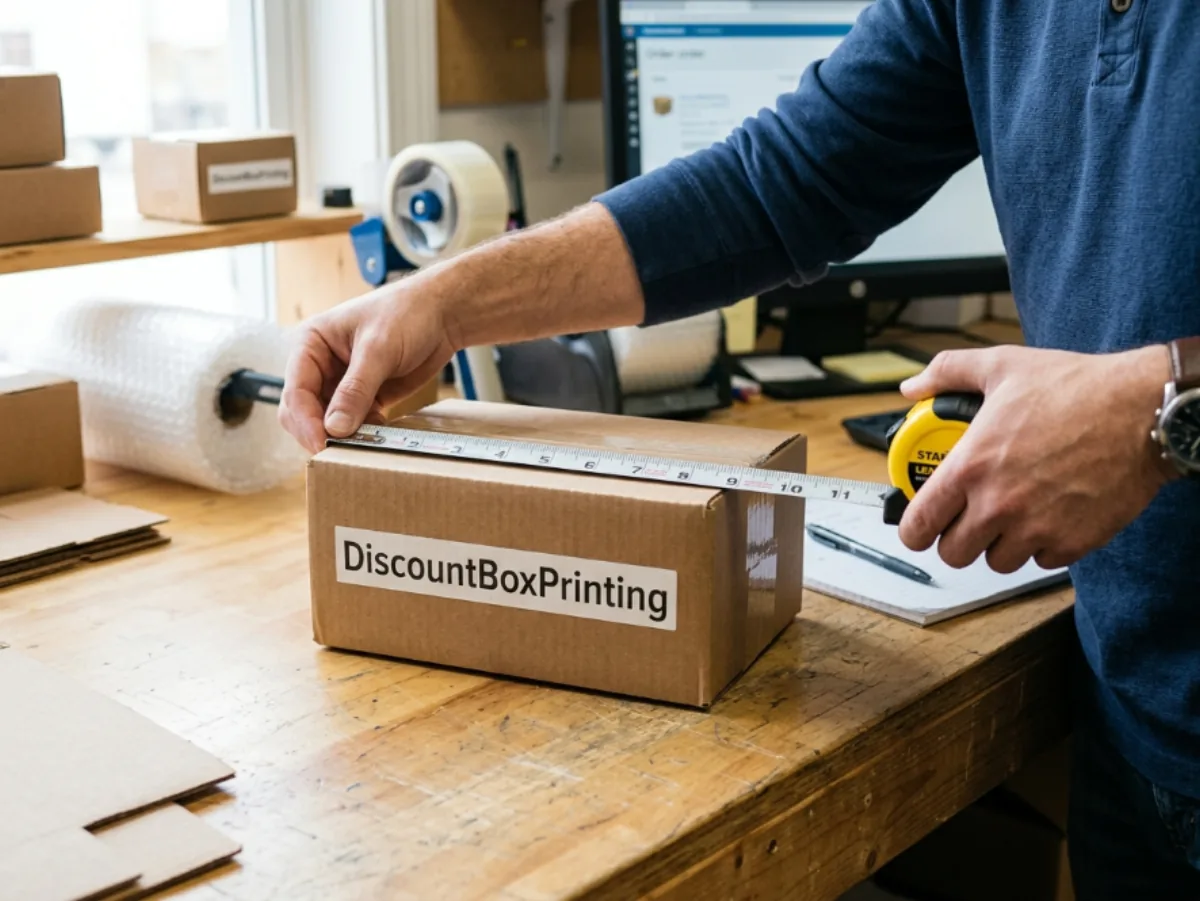
Lay the box flat with the flaps up. Then:
- Measure the long edge of the opening — that is the length.
- Measure the short edge of the opening — that is the width.
- Measure from the top edge straight down to the floor of the box — that is the height.
Use a steel tape or a ruler. Round to the nearest 1/16 inch for a snug fit. For a flat (knock-down) box, you measure the same way; the sides fold up to the same inside size.
Inside vs Outside Dimensions
Every box has two sets of sizes:
- Inside (interior) dimensions — the space inside the walls. Use these to pick a box for a product. The product needs to fit with a small pad on each side.
- Outside (exterior) dimensions — the box with the walls counted in. Carriers like UPS, FedEx, and USPS use outside sizes to set the freight rate.
A box with a 10 × 8 × 6 inside size might measure 10 1/4 × 8 1/4 × 6 1/4 outside, since the walls add about a quarter inch per side. For double-wall corrugated builds, the walls add more. See our corrugated box dimensions guide for board-by-board thickness.
Dimensional Weight and Shipping Cost
Carriers do not bill by weight alone. They also bill by DIM weight, which turns the box size into a weight. The formula:
DIM weight = (L × W × H) ÷ divisor
The divisor is set by the carrier — 139 for FedEx and UPS on most U.S. domestic parcels, 166 for USPS cubic. The higher of the real weight and the DIM weight is the billed weight. A right-sized box pays only for what it holds. A box that is too big pays for empty air.
Inches, Centimeters, and Millimeters
The United States uses inches. Most other markets use centimeters or millimeters. A quick swap:
| Inches | Centimeters | Millimeters |
|---|---|---|
| 1 in | 2.54 cm | 25.4 mm |
| 4 in | 10.16 cm | 101.6 mm |
| 12 in | 30.48 cm | 304.8 mm |
For U.S. carriers and most dielines, inches are the default. For export shipments and ISO paper sizes, metric is the standard. See our international packaging size standards guide for export rules.
Common Box Sizes You Can Order
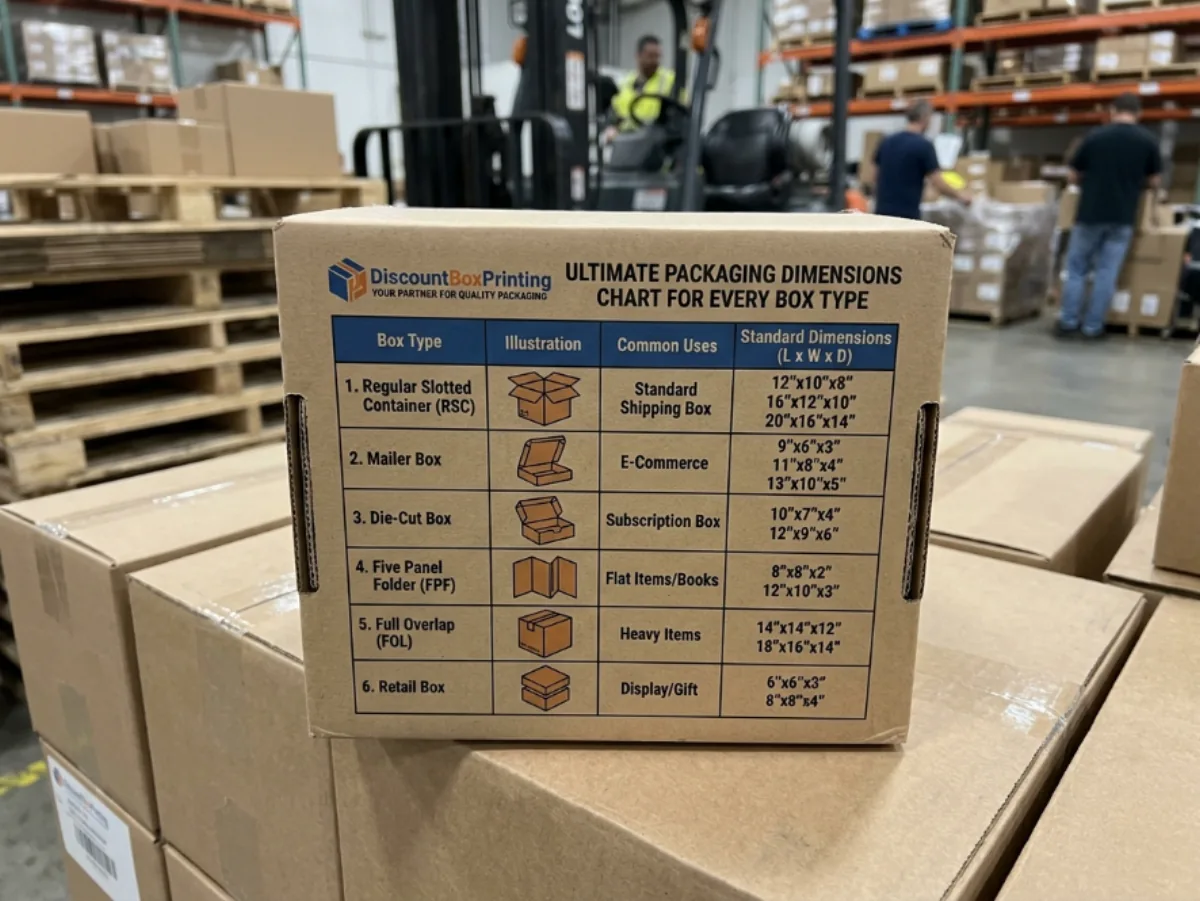
These are common U.S. sizes for custom runs. All are made to any inside L × W × H:
| Use | Inside (L × W × H) | Format |
|---|---|---|
| Small mailer | 8 × 6 × 2 in | E-flute mailer |
| Standard parcel | 10 × 8 × 6 in | 32 ECT RSC |
| Medium shipper | 12 × 10 × 8 in | 32 ECT RSC |
| Heavy parcel | 18 × 14 × 12 in | 44 ECT or double wall |
For more use-case tables, see our shipping box size chart and packaging dimensions chart.
Measuring Round or Odd Shapes
For a tube or a cylinder, swap length and width for diameter. The three numbers become diameter × diameter × height. For irregular shapes, measure the longest point in each direction so the box can hold the full item.
Carriers also use girth on long parcels. Girth is 2 × (W + H). The sum of length plus girth sets the oversize rule — a USPS parcel over 108 inches of length plus girth is treated as oversize and billed higher.
The Bottom Line
Three numbers set every box: length, width, and height. Read them in that order. Use inside sizes to fit the product. Use outside sizes to check the freight bill. Keep the box close to the product and the shipping cost stays low. For a free dieline sized to your spec and a wholesale quote, request a free quote.
Explore More
Ready to put this into action? Explore our Custom Shipping Boxes and Custom Mailer Boxes, and read our guides on how to measure packaging dimensions, the shipping box size chart, and the product packaging dimensions guide.
Frequently Asked Questions
What does L × W × H mean on a box?
L × W × H lists the three sides of a box in a fixed order: length, width, then height. Length is the longest side of the opening, width is the shorter side of the opening, and height is the depth from the opening to the base. Every carrier, factory, and dieline uses the same order.
In what order are box dimensions listed?
Box dimensions are always listed as length × width × height, in that order. Length comes first and is the longest edge of the open face. Width is the shorter edge of the same face. Height is the depth. A box labeled 12 × 10 × 8 is 12 inches long, 10 inches wide, and 8 inches tall.
Should I use inside or outside dimensions?
Use inside (interior) dimensions to pick a box for your product, so the item fits with a small pad on each side. Use outside (exterior) dimensions for shipping cost, since UPS, FedEx, and USPS price by the box's outside size. A box with a 10 × 8 × 6 inside size is typically about 10 1/4 × 8 1/4 × 6 1/4 outside.
What is dimensional weight?
Dimensional weight (DIM weight) is a shipping charge based on the box size, not the real weight. The formula is (L × W × H) divided by a carrier divisor — 139 for FedEx and UPS on most domestic U.S. parcels, 166 for USPS cubic. The carrier bills the higher of the real weight and the DIM weight.
Should I measure in inches or centimeters?
Use inches for U.S. carriers (UPS, FedEx, USPS) and for most dielines made in the United States. Use centimeters or millimeters for export shipments and for ISO paper sizes. One inch equals 2.54 centimeters or 25.4 millimeters.
How do I measure an irregular or cylindrical product?
For a cylinder or tube, swap length and width for diameter. The three numbers become diameter × diameter × height. For an odd shape, measure the longest point in each direction so the box fits the full item. Add 1/4 to 1/2 inch of pad space on each side for cushioning.
What is girth and when does it matter?
Girth is twice the width plus twice the height — written as 2 × (W + H). Carriers use the sum of length plus girth to flag oversize parcels. USPS treats any parcel over 108 inches of length plus girth as oversize, which raises the shipping bill. Measure both numbers before you ship long items.
What price can I expect for custom boxes in bulk?
Wholesale custom boxes start from about $0.10 per unit at Discount Box Printing, with the final price set by L × W × H, board grade, print colors, and run size. Larger orders cut the per-unit cost by a wide margin, and you can send a competing quote to our <a href="/beat-my-quote">Beat My Quote</a> page to lock in a better rate.
What is the minimum order quantity for custom boxes?
We print custom boxes to any L × W × H with a low minimum order, so small brands and new product lines can start without a big spend. Low MOQs let you test art and sizes on the shelf before you scale up, and when you reorder in bulk the per-unit price drops. Reach out for the exact MOQ on your spec.
How long does it take to print and deliver custom boxes?
Standard turnaround on custom boxes is about 10 to 12 business days after proof approval, with a 6 to 8 day rush option on most jobs. Timing starts once the dieline and art are signed off, so a fast proof reply keeps the clock short. Free U.S. ground shipping is included on every order.
Do you offer free design, a dieline, and a 3D mockup?
Yes. Every custom box order at Discount Box Printing includes free design help, a print-ready dieline sized to your L × W × H, and a 3D mockup before we go to press. Our team cleans up logos, sets bleeds, and checks food-safe inks when needed, so the box you approve on screen is the box you receive.
Do you ship custom boxes across the United States?
Yes. We make custom boxes factory-direct and ship to every state in the US with free ground freight on wholesale orders. Our team at Discount Box Printing coordinates print, cut, and dispatch under one roof, so your boxes land on time whether you order from New York, Texas, California, or anywhere between.
Ready to order your custom boxes?
Free design, low minimums, fast turnaround — at wholesale prices.
Get a Free QuoteRelated Packaging
Products and categories mentioned in this article.
Custom Shipping Boxes
Custom Mailer Boxes
Related Posts
How to Measure Packaging Dimensions Correctly
Die-Cut Box Dimensions: Sizes & Custom Shapes Guide