888-450-3725

In this article
- What are the dimensions of a playing card?
- Standard Playing Card Sizes at a Glance
- Poker-Size Cards (2.5 × 3.5 in)
- Bridge-Size Cards (2.25 × 3.5 in)
- Tarot Card Dimensions
- Mini, Jumbo, and Trading Cards
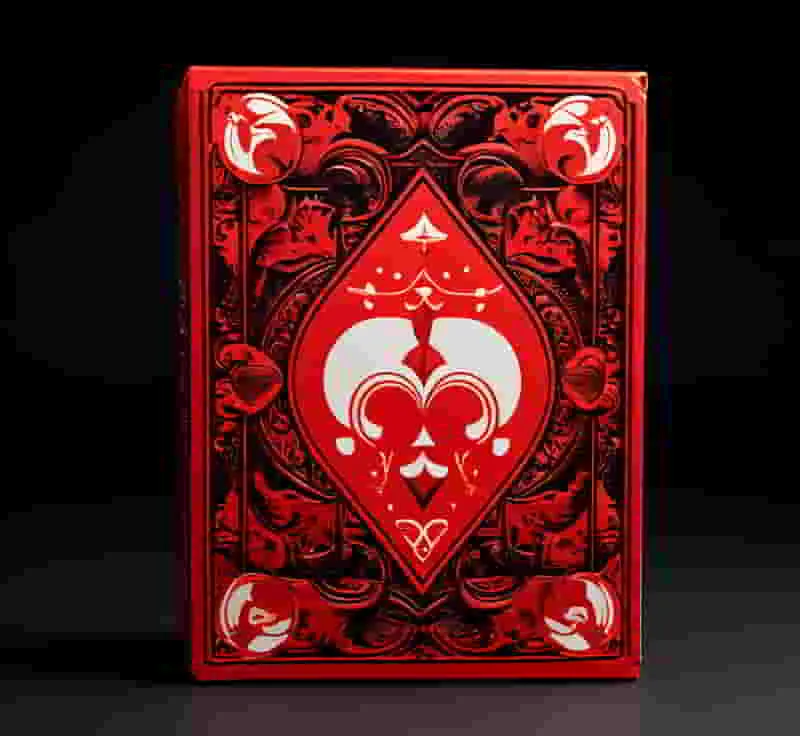
- Deck Thickness and Deck Box Dimensions
- Card Paper, Finish, and Core
- Printing Custom Playing Cards and Deck Boxes
- The Bottom Line
Playing cards come in a short list of standard sizes. Pick the wrong one and the deck does not fit the box, the fan does not look right, and the printer has to redo the dieline. This guide walks through every standard playing card size, deck thickness, and deck-box dimension in both inches and millimeters. At Discount Box Printing we make custom game boxes and tuck boxes for cards factory-direct across the United States.
What are the dimensions of a playing card?
A standard poker-size playing card is 2.5 × 3.5 inches (63.5 × 88.9 mm). A bridge-size card is narrower at 2.25 × 3.5 inches (57 × 88.9 mm). A tarot card is larger at about 2.75 × 4.75 inches (70 × 120 mm). Most trading cards share the poker size. We print custom card decks and tuck boxes factory-direct from $0.10 per unit. Beat any box quote.
- Poker — 2.5 × 3.5 in (63.5 × 88.9 mm) — the U.S. standard
- Bridge — 2.25 × 3.5 in (57 × 88.9 mm) — narrower; common in Europe
- Tarot — 2.75 × 4.75 in (70 × 120 mm)
- Mini — 1.75 × 2.5 in (44 × 63 mm)
- Jumbo — 3.5 × 5.75 in (89 × 146 mm)
- Deck thickness — 54 cards is about 0.75 in (19 mm) at 310 gsm
- Corner radius — 1/8 in (3.2 mm) is the industry standard
Standard Playing Card Sizes at a Glance
Every deck follows one of five size families. Below is the common range in both inches and millimeters:
| Format | Width × Height (in) | Width × Height (mm) | Common Use |
|---|---|---|---|
| Poker | 2.5 × 3.5 | 63.5 × 88.9 | U.S. casino, home play, most trading cards |
| Bridge | 2.25 × 3.5 | 57 × 88.9 | Bridge, canasta, European trick-taking games |
| Tarot | 2.75 × 4.75 | 70 × 120 | Tarot and oracle decks |
| Mini (half) | 1.75 × 2.5 | 44 × 63 | Travel, kids, promo giveaways |
| Jumbo | 3.5 × 5.75 | 89 × 146 | Low-vision play, teaching decks |
Height is almost always 3.5 inches — it is the width that sets poker apart from bridge. Tarot is the odd one out at 4.75 inches tall.
Poker-Size Cards (2.5 × 3.5 in)
Poker-size is the most common playing card format in the U.S. market. It is used in casinos, home-play decks, and almost every modern trading card game. A full deck of 52 cards plus 2 jokers — 54 cards — is about 0.75 inches thick on 310 gsm casino stock. Corners are rounded with a 1/8-inch radius so the cards shuffle smoothly and do not fray.
Bridge-Size Cards (2.25 × 3.5 in)
Bridge-size cards are a quarter inch narrower than poker. The narrower width lets a player hold 13 cards in a fan without the hand looking too wide. Bridge-size is the European standard for trick-taking games like bridge, canasta, and skat. Height stays the same at 3.5 inches, so a bridge deck is only slightly smaller overall than a poker deck.
Tarot Card Dimensions
Tarot cards are larger than a poker card to give the artwork more room. The common size is 2.75 × 4.75 inches (70 × 120 mm), used by nearly every classic Rider–Waite style deck. Oracle decks and some art decks run a little larger — 3.5 × 5 inches is not unusual. A full 78-card tarot deck on 350 gsm stock is close to 1.1 inches thick.
Mini, Jumbo, and Trading Cards
Beyond the three classics, three more formats are worth knowing:
- Mini (half-size) — 1.75 × 2.5 in (44 × 63 mm). Used for travel decks, kid card games, and promotional giveaways.
- Jumbo — 3.5 × 5.75 in (89 × 146 mm). Low-vision and teaching decks for classrooms.
- Trading cards (TCG) — 2.5 × 3.5 in. Magic: the Gathering, Pokemon, Yu-Gi-Oh, baseball, and most sports cards share the poker size.
Business cards are not playing cards, but they share nearby dimensions — a U.S. business card is 3.5 × 2 inches, laid out landscape rather than portrait.
Deck Thickness and Deck Box Dimensions
A playing card is thin, but 54 of them stack up. On typical 310 gsm casino-grade stock, a card is about 0.012 inches thick, so a 54-card deck is about 0.65 to 0.75 inches thick. Heavier stock, foil, or embossed finishes push the deck thickness closer to 0.9 inches.
Tuck boxes are sized to the deck plus a small amount of slack so the cards slide in and out cleanly. Common U.S. tuck-box outside sizes:
| Deck | Tuck Box Outside (L × W × H) | Capacity |
|---|---|---|
| Poker | 2.6 × 0.9 × 3.6 in | 54-card deck |
| Bridge | 2.4 × 0.9 × 3.6 in | 54-card deck |
| Tarot | 2.9 × 1.4 × 4.9 in | 78-card deck |
| Mini | 1.85 × 0.7 × 2.6 in | 54-card deck |
For a two-deck gift set or a collector tin-style rigid box, add 0.3 to 0.5 inches per extra deck plus a divider.
Card Paper, Finish, and Core
Three specs set a quality playing card:
- Paper weight — 300 to 350 gsm. 310 gsm is the casino standard; heavier stocks suit tarot and art decks.
- Finish — air cushion for a smooth shuffle, linen for a textured grip, or smooth for a budget feel.
- Black core — an opaque middle layer that stops light from showing the face through the back. It is the key spec for serious decks.
Add rounded 1/8-inch corners, a card-safe UV coating, and a shrink wrap, and the deck is ready for retail.
Printing Custom Playing Cards and Deck Boxes
Custom cards are printed on 310 to 350 gsm black-core stock, cut with a 1/8-inch corner radius, and shrink wrapped inside a tuck or rigid box. Artwork needs a 1/8-inch bleed on every edge, a 1/8-inch safety margin inside the cut line, and brand color in Pantone (PMS) values. We send a free dieline sized to the deck and the box so the fit is exact. See our how to measure packaging dimensions guide for the measuring steps and our L × W × H guide for how to read dimensions on any dieline.
The Bottom Line
Four numbers set every playing card build: the card size, the deck count, the deck thickness, and the tuck box fit. Poker is the U.S. default. Bridge is the European narrow. Tarot is the oversized art deck. Get the deck right and the tuck box is a quick dieline step. For a free dieline sized to your deck and a wholesale quote, request a free quote.
Explore More
Ready to put this into action? Explore our Custom Game Boxes and Rigid Boxes for deck sets, and read our guides on length, width, and height dimensions, the how to measure packaging dimensions walk-through, and the retail packaging size guide.
Frequently Asked Questions
What size is a standard playing card?
A standard poker-size playing card is 2.5 × 3.5 inches (63.5 × 88.9 mm). It is the most common size in the U.S. market and the base for almost every modern trading card game. A bridge-size card is narrower at 2.25 × 3.5 inches, and a tarot card is larger at about 2.75 × 4.75 inches.
What is the difference between poker and bridge playing cards?
Poker-size cards are 2.5 inches wide, bridge-size cards are 2.25 inches wide; both are 3.5 inches tall. The quarter-inch narrower bridge format lets a player fan 13 cards in one hand without the hand looking too wide, which is why bridge, canasta, and most European trick-taking games prefer it.
What are tarot card dimensions?
A standard tarot card is 2.75 × 4.75 inches (70 × 120 mm). Oracle and art tarot decks sometimes run larger at 3.5 × 5 inches. A full 78-card tarot deck on 350 gsm stock is about 1.1 inches thick, so the tuck box is noticeably deeper than a poker tuck box.
How thick is a deck of playing cards?
A 54-card poker deck on standard 310 gsm casino stock is about 0.65 to 0.75 inches thick (16 to 19 mm). Heavier stocks, foil layers, or embossed finishes can push a deck to 0.9 inches. For deck-box dieline work, use the actual stock thickness, not an average.
What size are trading cards and sports cards?
Most modern trading cards share the poker size at 2.5 × 3.5 inches (63.5 × 88.9 mm). Magic: the Gathering, Pokemon, Yu-Gi-Oh, and most baseball cards all use this size. The uniform spec is why one sleeve, binder, or deck box fits almost every trading card game.
What is the corner radius on a playing card?
The industry standard corner radius is 1/8 inch (3.2 mm). Rounded corners let the cards shuffle smoothly without fraying and keep every card the same shape after thousands of hands. Custom decks can order a sharper or softer radius, but 1/8 inch is the near-universal default.
What paper weight is used for playing cards?
Playing cards print on 300 to 350 gsm card stock. 310 gsm with a black core is the casino standard — the opaque core stops light from showing the face through the back of the card. Tarot and art decks often step up to 350 gsm for a weightier feel in the hand.
What price can I expect for custom playing cards and boxes in bulk?
Wholesale custom playing card boxes start from about $0.10 per unit at Discount Box Printing, with the final price set by card size, deck count, print colors, and run size. Larger orders cut the per-unit cost by a wide margin, and you can send a competing quote to our <a href="/beat-my-quote">Beat My Quote</a> page to lock in a better rate.
What is the minimum order quantity for custom deck boxes?
We print custom playing card and deck boxes to any deck size with a low minimum order, so small game publishers and new product lines can start without a big spend. Low MOQs let you test art on the shelf before you scale up, and when you reorder in bulk the per-unit price drops. Reach out for the exact MOQ on your spec.
How long does it take to print and deliver custom deck boxes?
Standard turnaround on custom deck and card boxes is about 10 to 12 business days after proof approval, with a 6 to 8 day rush option on most jobs. Timing starts once the dieline and art are signed off, so a fast proof reply keeps the clock short. Free U.S. ground shipping is included on every order.
Do you offer free design, a dieline, and a 3D mockup for playing card boxes?
Yes. Every custom deck or tuck-box order at Discount Box Printing includes free design help, a print-ready dieline sized to your card size and deck thickness, and a 3D mockup before we go to press. Our team cleans up logos, sets bleeds, and checks card-safe inks, so the box you approve on screen is the box you receive.
Do you ship custom deck boxes across the United States?
Yes. We make custom deck and card boxes factory-direct and ship to every state in the US with free ground freight on wholesale orders. Our team at Discount Box Printing coordinates print, cut, and dispatch under one roof, so your boxes land on time whether you order from New York, Texas, California, or anywhere between.
Ready to order your custom boxes?
Free design, low minimums, fast turnaround — at wholesale prices.
Get a Free Quote
Related Posts
Die-Cut Box Dimensions: Sizes & Custom Shapes Guide